
Gruhalakshmi application status 2026 is checked in three official ways in Karnataka: by SMS from the ration card number, inside the DBT Karnataka mobile app, and on the Seva Sindhu application-status page. All three were checked on 22.08.2026. This page covers the status routes, the apply route and its last date, the amount release position, eligibility, documents, the beneficiary-list review, mobile-number correction and the official helpline numbers.
Checking status online
| Gruhalakshmi status check | Official route |
|---|---|
| Status check by SMS | SMS your ration card number to 8147500500 or 8277000555. |
| Application status | Check it on the Seva Sindhu status page. |
| Payment status | Check credits in the DBT Karnataka mobile app. |
| DBT tracker website | The website tracker link shows a 404 error. |
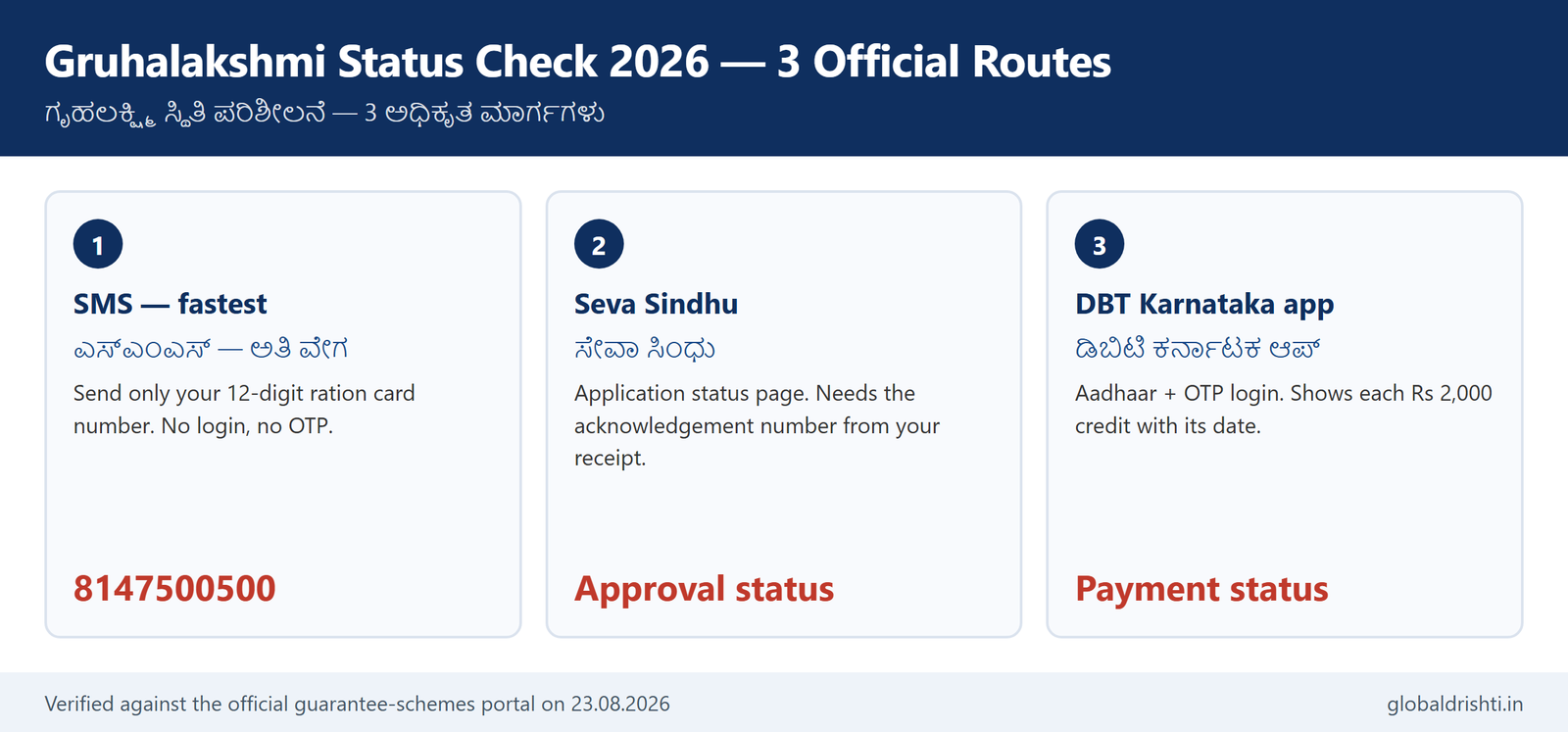
Note: For the SMS route, send only the 12-digit ration card number. No login, OTP or app is needed, and both numbers are printed on the official guarantee-schemes home page. The Seva Sindhu page needs the acknowledgement or application reference number from the service centre, not the ration card or Aadhaar number. Entering the wrong number is the usual reason it shows nothing. The DBT Karnataka app logs in with Aadhaar and an OTP to the Aadhaar-linked mobile, and shows whether and when the Rs 2,000 was credited. Application status says whether the household record was approved. Payment status says whether a month’s Rs 2,000 reached the bank. Approved but not credited is a bank or Aadhaar-seeding problem. The DBT tracker link on the guarantee-schemes home page returned a 404 error as on 22.08.2026.
Important Links
| Link | Status |
|---|---|
| Application status | Click here · Live |
| Guarantee schemes portal | Click here · Live |
| WCD scheme page | Click here · Live |
| Government order PDF | Click here · 06.06.2023 |
| Terms and conditions PDF | Click here · Live |
| Application form PDF | Click here · Live |
| Helpline page | Click here · Live |
| Seva Sindhu services | Click here · Live |
| Status by SMS | 8147500500 / 8277000555 |
| Status guide PDF (English + ಕನ್ನಡ) | Click here |
| Sarkari Naukri updates | Click here |
| Karnataka Yuva Nidhi | Click here |
| Karnataka Anna Bhagya | Click here |
Note: For the SMS route send the 12-digit ration card number. Related schemes: Yuva Nidhi pays Rs 3,000 a month to unemployed graduates and Rs 1,500 to diploma holders. Anna Bhagya gives 10 kg free rice, or the DBT amount when rice is not issued. The Yadgir artisan tool grant closed on 31.07.2026 with lottery selection.
Checking status by SMS and the DBT app
- Open the messaging app on the mobile number registered with the scheme.
- Type only the 12-digit ration card number, with no extra words, and send it to 8147500500 or 8277000555.
- Read the reply. It reports the registration or payment position recorded against that ration card.
- For a month-by-month money trail, install the DBT Karnataka app from the Google Play Store.
- Enter the Aadhaar number of the woman named as head of the family, request the OTP and enter the six digits sent to the Aadhaar-linked mobile.
- Open the Gruha Lakshmi section inside the app. It shows each credited installment with its transfer date.
- To confirm approval rather than payment, open the Seva Sindhu application-status page listed in the Important Links table above and enter the acknowledgement number from the application receipt.
Pending status and missing names
| Gruhalakshmi pending status | Likely cause |
|---|---|
| No record found | The ration card number was mistyped or the card was reissued. |
| Pending verification | Back-end verification is still open, it is not a rejection. |
| Approved but no money | Aadhaar is almost always not seeded to the bank account. |
| Name removed | Income tax, GST filing or a ration card change removed it. |
| Others got money first | Payments go in batches, so wait a few working days. |
| Money taken back | It was paid on wrong information and has been recovered. |
Note: If the ration card was reissued with a new number, the record is corrected at a Karnataka One, Bangalore One or Grama One centre. Sanction is granted on the form’s self-declaration and verified afterwards, so pending means that verification has not closed. Ask the bank to seed Aadhaar for DBT, not merely record it. A record drops out if the woman head of family or her husband pays income tax or files GST returns, or if an updated ration card no longer shows her as head. Wait three to four working days after a release before treating it as a failure, then check the account for dormancy or expired KYC. The conditions allow recovery of money obtained on wrong information. Correct the record rather than reapplying with the same details.
How to apply for Gruhalakshmi scheme online and offline
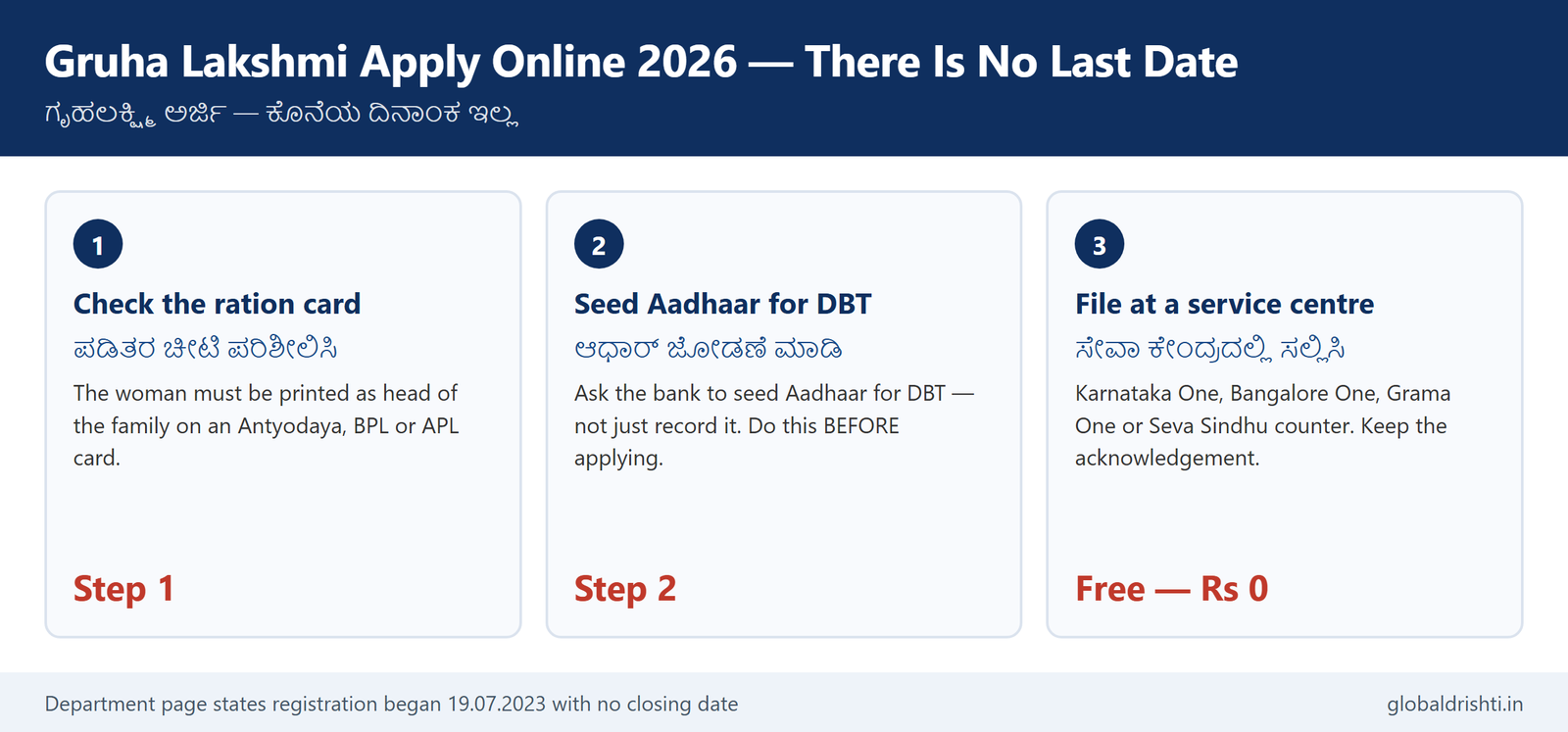
- Confirm that the woman applying is the one printed as head of the family on the Antyodaya, BPL or APL ration card. The scheme is tied to that entry.
- Collect the ration card, the Aadhaar card of the woman head of family, and the bank passbook of the account where the money should land.
- Confirm at the bank that this account is Aadhaar-seeded for DBT. Doing this before the application saves the most common failure later.
- Visit a Karnataka One, Bangalore One or Grama One centre, or the Seva Sindhu portal counter, and ask the operator to file the Gruha Lakshmi registration. There is no fee.
- Alternatively download the official application form PDF linked in the Important Links table above, fill it, and submit it at the same centres.
- Collect the acknowledgement and keep the application reference number. Every later status check on Seva Sindhu depends on it.
Release date and installment position
| Gruhalakshmi amount | On record |
|---|---|
| Monthly amount | The woman head of family gets Rs 2,000 a month. |
| Release date | No fixed monthly release date is published. |
| 32nd instalment | Rs 2,443 crore was released on 08.08.2026. |
| Total paid so far | Rs 76,951 crore has been paid across 32 instalments. |
| Number of beneficiaries | 1,24,48,938 women are beneficiaries. |
| Amount per woman | About Rs 64,000 per woman since August 2023. |
| DBT payment start | DBT payments began on 30.08.2023. |
Note: The Rs 2,000 goes by DBT to the woman recorded as head of the family, unchanged since the government order of 06.06.2023. The department publishes no fixed monthly date: the treasury issues a release order and the credit rolls out in batches, with money reaching accounts within three to four days of the 08.08.2026 release. The total covers 32 instalments, per figures given on 21.08.2026. The per-beneficiary figure since August 2023 is our division. DBT payment followed guidelines of 17.07.2023. Late months have been paid together in past cycles rather than cancelled. Only the DBT app ledger confirms what reached your account.
Gruha Lakshmi amount not received this month
| Gruhalakshmi money not credited | Fix |
|---|---|
| Aadhaar not seeded | Ask your bank branch to seed Aadhaar for DBT. |
| Old bank account | Move the Aadhaar mapping to your current account. |
| Dormant account | Reactivate the account or renew its KYC at the bank. |
| Ration card changed | Correct the ration card first, then the scheme record. |
| Late this month | Wait 3 – 4 working days after the release. |
| Income tax or GST found | The record stops and no helpline can reverse it. |
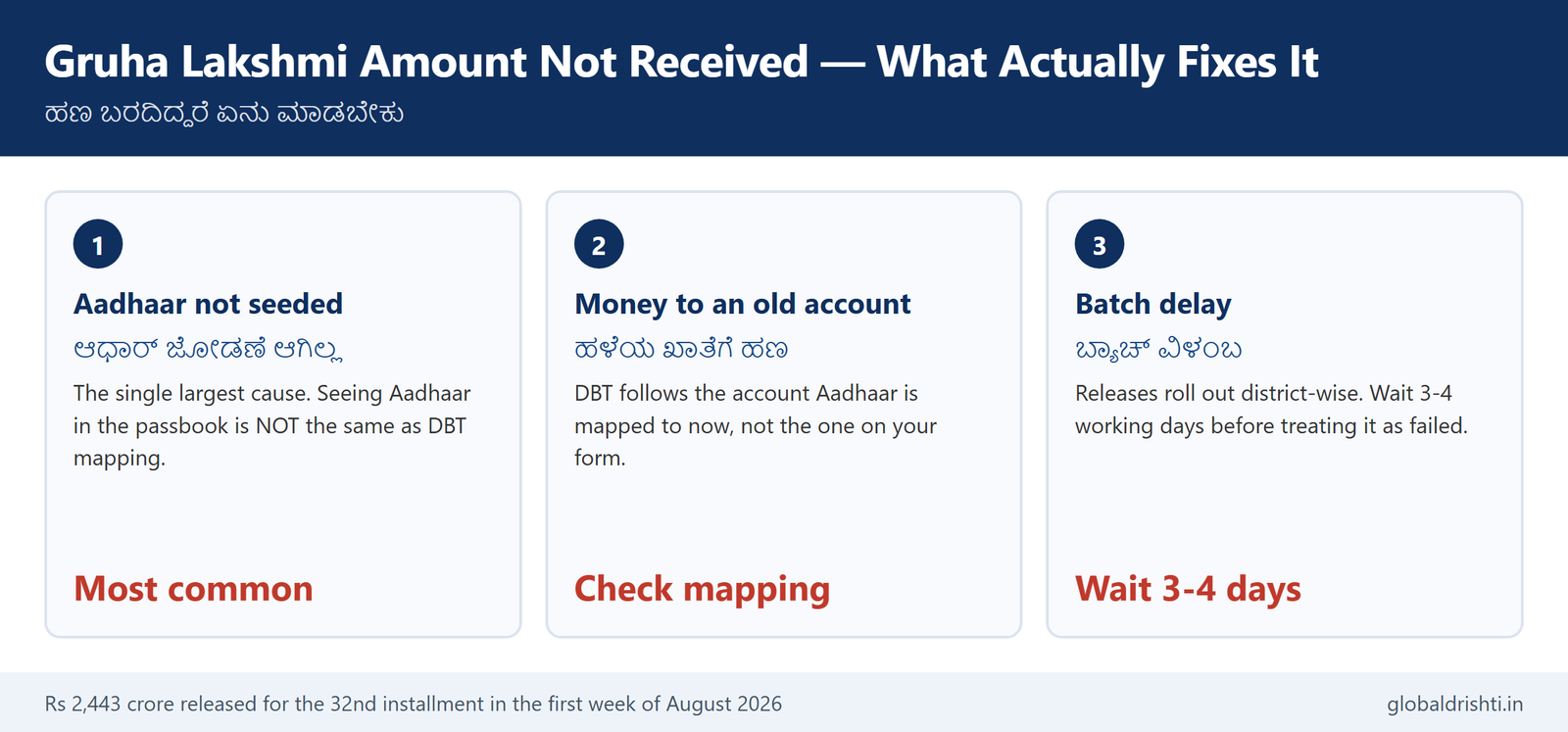
Note: Aadhaar seeding is the largest cause of a failed credit. An Aadhaar number printed in the passbook is not the same as DBT mapping, so ask the branch to seed it for direct benefit transfer and keep the acknowledgement. DBT goes to the account Aadhaar is currently mapped to, not the one on the form. Banks reject credits to frozen or KYC-expired accounts. After a card change, correct the card, then the scheme record at the service centre. The DBT app ledger shows whether a transfer was attempted and failed or never attempted. An income-tax or GST disqualification is a stated scheme condition that no helpline can reverse.
Gruhalakshmi eligibility 2026, who is eligible
| Gruhalakshmi eligibility | Government order |
|---|---|
| Who is eligible | The woman named as head of household on the ration card. |
| Ration card type | Antyodaya, BPL or APL cards all qualify. |
| Women per family | Only one woman per family gets the money. |
| Gender minorities | Gender minorities are covered by the scheme. |
| Not eligible | Families where she or her husband pays income tax or GST. |
| Age or income limit | The order sets no age limit and no income certificate. |
| Bank condition | Her bank account must be linked with Aadhaar. |
Note: The ration card is issued by the Food and Civil Supplies department, and its head-of-household entry is the qualifying test, with no income proof. Only one woman per family qualifies even if several adult women share the card. Gender minorities were added by an administrative approval dated 18.07.2023. The disqualification applies if the woman head or her husband pays income tax or files GST returns. The order sets no age band and asks for no income certificate.
Gruhalakshmi documents required for the application
| Gruhalakshmi documents | Why needed |
|---|---|
| Ration card | It proves eligibility and is used for SMS status. |
| Aadhaar card | It proves identity and logs in to the DBT app. |
| Bank passbook | It gives the account number and IFSC. |
| Husband’s Aadhaar | It is used for the income tax and GST check. |
| Self-declaration | Sanction is granted on this declaration. |
| Not required | No income or caste certificate and no fee. |
Note: The ration card must show the woman as head of the family, and its 12-digit number is what the SMS route reads. Her Aadhaar-linked mobile must be reachable for the OTP. The account must be Aadhaar-seeded for DBT or the credit fails even after approval. A false declaration allows recovery of money already paid and further action.
Beneficiary list and the biometric review
| Gruhalakshmi beneficiary list | Position |
|---|---|
| List PDF download | No official beneficiary list PDF is published. |
| Check own name | Use the SMS route with your ration card number. |
| Deleted list | No deleted or cancelled list is published. |
| Biometric verification | The review uses biometric and face authentication. |
| Verification app | The review app has not been released yet. |
| Verification deadline | No deadline has been notified by the department. |
Note: Verified on 22.08.2026. No statewide or village-wise list is on the department or guarantee-schemes portal, so sites offering one are not carrying an official document. A dropped record shows up as a failed status against your own ration card. Per the statement of 21.08.2026, the review runs through Seva Sindhu Kendras and a door-to-door survey, and an app built by the Centre for e-Governance was in final review. Treat any deadline on social media as unverified until the department publishes it.
Gruhalakshmi re-application, renewal and KYC update
| Gruhalakshmi re-apply | Confirmed position |
|---|---|
| Re-application | No re-application has been announced. |
| Yearly renewal | There is no yearly renewal step. |
| Online KYC | There is no online KYC screen for the scheme. |
| Review venue | Reviews happen at Seva Sindhu Kendras and door to door. |
| Documents to keep | Keep your ration card, Aadhaar and bank details ready. |
| Fee | Registration and review are free. |
Note: As on 22.08.2026 there is no reapplication form, window or circular. Fresh criteria for new applications are being drafted. An approved record keeps being paid unless verification removes it. Bank KYC is done at the branch and Aadhaar details at an Aadhaar centre. The scheme record is corrected at a service centre. The review follows the 21.08.2026 statement and is not a form filled at home. Keep a working Aadhaar-linked mobile and a live Aadhaar-seeded account.
Gruhalakshmi phone number update and record correction
| Gruhalakshmi correction and apply | Where |
|---|---|
| Mobile number update | Change it at an Aadhaar centre, not the scheme counter. |
| SMS reply number | Replies come to whichever phone sends the SMS. |
| Bank account change | Ask the new branch to seed Aadhaar for DBT. |
| Head of family change | Correct the ration card first. |
| Lost acknowledgement | The service centre that filed it can retrieve it. |
| OTP by phone call | Any caller asking for an OTP is a fraud. |
| Last date to apply | There is no last date for registration. |
| Registration start | Registration started on 19.07.2023. |
| Where to apply | Apply at Karnataka One, Bangalore One or Grama One. |
| New applications | New criteria for fresh applications are being drafted. |
| Offline form | The printed form PDF is on the official portal. |
| Application cost | Applying is free at all official centres. |
Note: The DBT app uses the Aadhaar-linked number, so it changes at an Aadhaar centre. SMS replies go to whichever phone sends the ration card number. Money follows the Aadhaar mapping until it moves. The head-of-family entry is fixed by the Food and Civil Supplies department before the scheme record. Carry the ration card and the woman’s Aadhaar to retrieve a lost acknowledgement number, which is what the Seva Sindhu status page reads. No official route asks for an OTP by phone or charges a fee. The WCD page says registration started on 19.07.2023 with no last date, so any closing date quoted elsewhere is wrong. Registration is taken free at Karnataka One, Bangalore One, Grama One and by the Seva Sindhu operator. There is no self-service form at home. The 21.08.2026 statement said fresh criteria for new Gruha Lakshmi and Gruha Jyothi applications are being prepared, with online and offline submission expected. The printed form is linked in Important Links above.
Gruhalakshmi helpline number and complaint route
| Gruhalakshmi helpline number | Number |
|---|---|
| Scheme helpline | Call 1902 for scheme information. |
| Technical help | Call 080-2227 9954 for application and technical help. |
| Other numbers | 8792 662814 and 8792 662816 also help. |
| Status SMS numbers | 8147500500 and 8277000555 take SMS only, not calls. |
| In-person help | Visit your filing centre or the WCD district office. |
Note: All numbers are from the official guarantee-schemes contact page. 1902 covers every Karnataka guarantee scheme. The SMS numbers take the 12-digit ration card number. When complaining, carry the acknowledgement number, ration card, Aadhaar and a bank statement for the disputed months. Helpline numbers on aggregator sites often contradict each other.
Gruhalakshmi status check in Kannada, ಗೃಹಲಕ್ಷ್ಮಿ ಸ್ಥಿತಿ ಪರಿಶೀಲನೆ
Note: ಸ್ಥಿತಿ: ನಿಮ್ಮ 12 ಅಂಕಿಯ ಪಡಿತರ ಚೀಟಿ ಸಂಖ್ಯೆಯನ್ನು 8147500500 ಅಥವಾ 8277000555 ಗೆ SMS ಮಾಡಿ. ಹಣ: ಕುಟುಂಬದ ಯಜಮಾನಿ ಮಹಿಳೆಗೆ ಪ್ರತಿ ತಿಂಗಳು ರೂ. 2000. ಅರ್ಹರಲ್ಲ: ಯಜಮಾನಿ ಅಥವಾ ಆಕೆಯ ಪತಿ ಆದಾಯ ತೆರಿಗೆ ಅಥವಾ GST ಪಾವತಿದಾರರಾಗಿದ್ದರೆ. ಹಣ ಬರದಿದ್ದರೆ: ಆಧಾರ್ ಮತ್ತು ಬ್ಯಾಂಕ್ ಖಾತೆ ಜೋಡಣೆ ಪರಿಶೀಲಿಸಿ, ನಂತರ 1902 ಅಥವಾ 080-2227 9954 ಗೆ ಕರೆ ಮಾಡಿ.

Tracks central and state government recruitment notifications, admit cards, results and cut-offs for Global Drishti, verified directly against official recruitment portals and notification PDFs. Trusted by students and job aspirants nationwide.
Frequently Asked Questions
How do I check my Gruhalakshmi application status?
Send your 12-digit ration card number by SMS to 8147500500 or 8277000555, the two numbers printed on the official Karnataka guarantee-schemes portal. For approval status, use the Seva Sindhu application-status page with the acknowledgement number from your application receipt.
What is the last date to apply for the Gruha Lakshmi scheme?
There is no last date. The Women and Child Development department page states that registration started on 19.07.2023 and that there is no last date for the registration process.
How much is the Gruha Lakshmi amount and when is it released?
Rs 2,000 per month by DBT to the Aadhaar-linked account of the woman head of the family. No fixed monthly release date is published; the treasury issues a release order and the credit rolls out in batches over the following days.
Which Gruha Lakshmi installment has been released?
Rs 2,443 crore was reported released for the 32nd installment on 08.08.2026, with the state saying the money would reach accounts by direct bank transfer within three to four days.
Who is eligible for the Gruhalakshmi scheme?
The woman named as head of the household on an Antyodaya, BPL or APL ration card issued by the Food and Civil Supplies department. Gender minorities were also covered by administrative approval dated 18.07.2023.
Who is not eligible for Gruha Lakshmi?
Only two disqualifications are stated in the government order: the woman head of the family or her husband being an income-tax payer, or filing GST returns. There is no age limit and no income certificate condition.
Why is my Gruha Lakshmi amount not credited this month?
The most common cause is that Aadhaar is not seeded with your bank account for DBT, or the money is still mapped to an older account. A dormant or KYC-expired account, or a changed ration card, will also stop the credit.
Is there a Gruhalakshmi beneficiary list PDF to download?
No statewide beneficiary list, village-wise name list or deleted list is published on the department or guarantee-schemes portal. The SMS check against your own ration card number is the official individual route.
Is Gruhalakshmi re-application or biometric verification compulsory now?
As on 22.08.2026 no reapplication form, window or deadline has been notified on the official portal. A beneficiary-list review using biometric and face authentication through Seva Sindhu Kendras and a door-to-door survey was described on 21.08.2026, with the verification app still in final review.
What documents are required for the Gruhalakshmi application?
The ration card showing the woman as head of the family, her Aadhaar card, and the bank passbook of the Aadhaar-seeded account. The husband's details are captured for the income-tax and GST declaration. No income or caste certificate is required.
What is the Gruhalakshmi helpline number?
1902 is listed on the official contact page for information on all Karnataka guarantee schemes. For application and technical help the same page lists 080-2227 9954, 8792 662814 and 8792 662816.
How do I change the mobile number linked to Gruha Lakshmi?
There is no mobile-number field on the scheme portal. The number that matters for the DBT Karnataka app is the one linked to Aadhaar, so it is updated at an Aadhaar enrolment or update centre.
Is there a fee to apply for Gruha Lakshmi?
No. The department page records that free registration is provided at Karnataka One, Bangalore One, Grama One and the Seva Sindhu portal. Anyone charging a fee to file the application is charging for a free service.
How much has been paid under the scheme so far?
Rs 76,951 crore across 32 installments to 1,24,48,938 beneficiaries, per figures given on 21.08.2026, which is about Rs 64,000 per beneficiary since payments began on 30.08.2023.